

Anaheim has invested heavily in three young defensemen. One controls its most valuable offensive assignment, while the others are signed for years to come. The Ducks have faced a similar dilemma before — and the outcome may not be what everyone is hoping for.
Jackson LaCombe has 22 points through Anaheim’s first 18 games. Tristan Luneau has 13. The difference looks substantial until their power-play production is removed.
Both defensemen have exactly ten points outside the man advantage.
LaCombe quarterbacks one of the NHL’s most productive power plays, alongside Leo Carlsson, Cutter Gauthier, Beckett Sennecke and Mikael Granlund. Luneau receives occasional opportunities with the second unit, collecting three power-play points so far, including a goal against Pittsburgh on November 8. Their overall scoring totals reflect the difference in those assignments, even as both contribute offensively elsewhere.
For Anaheim, the arrangement is working exceptionally well. The Ducks have converted 38.5% of their power-play opportunities, and Joel Quenneville has every reason to preserve a combination that opponents have struggled to contain.
The complication is that Anaheim has committed its long-term future to more than one young offensive defenseman. Unlike the familiar prospect waiting behind an aging veteran, Luneau is competing for opportunities with someone who may be part of the same organization for most of the next decade.
Three defensemen, one offensive hierarchy
LaCombe’s emergence has been one of Anaheim’s major success stories. His skating, puck movement and growing confidence have made him a natural choice to direct the first power-play unit. In October 2025, the Ducks secured his future with an eight-year, $72 million extension running through 2033–34.
A year later, Anaheim made another considerable investment, signing Luneau to a six-year, $43.2 million extension after just 14 NHL appearances. General manager Pat Verbeek identified him as a future top-four defenseman. The agreement begins in 2027–28, allowing Luneau to finish his entry-level contract before the substantial increase in salary takes effect.
Luneau has given the Ducks reasons to believe in that investment. After two productive AHL seasons, he has established himself in Anaheim’s lineup, averaging almost 20 minutes while contributing regularly at even strength. His underlying results have been encouraging, although favorable offensive deployment and unusually efficient finishing have helped his early production. Four goals on just 23 shots are unlikely to represent a sustainable scoring rate.
His secondary power-play role is another encouraging sign. Anaheim has not excluded him from offensive responsibilities, and his recent production suggests he is becoming comfortable with NHL opportunities. But the gap between occasional second-unit minutes and directing the league’s most productive power play remains considerable.
Matching LaCombe’s non-power-play point total does not establish that Luneau would be equally effective running the first unit. Their responsibilities differ, as do the circumstances in which they generate offense. LaCombe has already demonstrated chemistry with Anaheim’s leading forwards, and his ability to organize the man advantage is valuable in its own right.
LaCombe is also not keeping the seat warm. At 25, with a long-term extension and an established role, he could remain Anaheim’s primary offensive quarterback throughout much of Luneau’s contract.
Pavel Mintyukov, the former first-round pick recorded 28 points as a rookie in 2023–24, but his offensive opportunities subsequently became more limited. He spent much of last season in a bottom-pairing role, at times finding himself outside the lineup altogether. His current responsibilities emphasize defensive situations and penalty killing rather than the power play.
In July, Anaheim nevertheless committed another $36 million over five years to the restricted free agent. Mintyukov’s two even-strength goals against Edmonton on November 5 demonstrated that his offensive instincts remain intact, although his underlying results have been less convincing than Luneau’s.
Beginning in 2027–28, the Ducks will have $23.4 million in combined annual contract commitments to LaCombe, Luneau and Mintyukov. Three young defensemen have received substantial financial backing, yet their paths to the organization’s most valuable offensive assignment are anything but equal.
Anaheim has committed to their futures without making their long-term offensive roles equally clear.
The opportunity that may never open
Anaheim has encountered the complications of a crowded blue line before.
In 2017, the Ducks had Cam Fowler, Hampus Lindholm, Sami Vatanen and Josh Manson among an established group of defensemen, with Shea Theodore and Brandon Montour emerging behind them. Facing the Vegas expansion draft, Anaheim agreed to send Theodore to the Golden Knights in exchange for their selection of Clayton Stoner, preserving other members of its defensive core.
Montour remained for another two seasons before being traded to Buffalo as Anaheim began reshaping its roster. Both defensemen eventually flourished elsewhere. Theodore developed into a cornerstone of Vegas’s defense and won the Stanley Cup in 2023. Montour became a 73-point defenseman with Florida before winning the championship in 2024.
Those departures came under different circumstances. Theodore’s was tied directly to expansion-draft protection and salary considerations, while Montour was traded during a broader roster retool. Neither transaction proves Anaheim failed to recognize their ability. The Ducks nevertheless developed two talented young defensemen whose greatest achievements came after they left.
The current situation differs in one important respect: Anaheim has already secured LaCombe, Luneau and Mintyukov under long-term contracts. No expansion draft is forcing an immediate decision, and the organization has time to accommodate different strengths within the same defensive group.
But successful power-play units tend to reinforce their own stability. Players develop chemistry, establish routines and become increasingly difficult to replace. Anaheim’s current group is particularly resistant to change because several of its central contributors are young enough to remain together for years.
A promising defenseman stuck behind a veteran approaching the end of his contract can reasonably anticipate an eventual opening. Luneau has no comparable timeline. LaCombe’s success could make his position more secure precisely as Luneau continues to improve.
Anaheim could eventually redistribute responsibilities, introduce different combinations or find more offensive opportunities for both players. It could also maintain the existing hierarchy while allowing Luneau to develop into a valuable top-four defenseman at even strength.
The contracts make those alternatives particularly interesting in dynasty formats. They demonstrate organizational commitment, but Anaheim’s agreements with LaCombe, Luneau and Mintyukov do not establish which player will receive the offensive assignments that most strongly influence fantasy production.
Mintyukov’s experience already demonstrates how a highly regarded young defenseman can receive a substantial contract without gaining a prominent offensive role. Luneau’s situation offers a different possibility: a player whose early NHL production and long-term financial commitment suggest considerable offensive potential, but whose path toward a larger special-teams assignment remains uncertain.
For now, Anaheim has no pressing reason to resolve that uncertainty. LaCombe is thriving, Luneau is producing and the power play is operating at a remarkable level.
A decade ago, Anaheim’s surplus of promising defensemen eventually became part of a series of difficult roster decisions. This time, the Ducks have committed to keeping their young core together. Whether they envision Luneau as a future power-play quarterback, a complementary offensive defenseman or something they have not yet needed him to become remains unanswered.
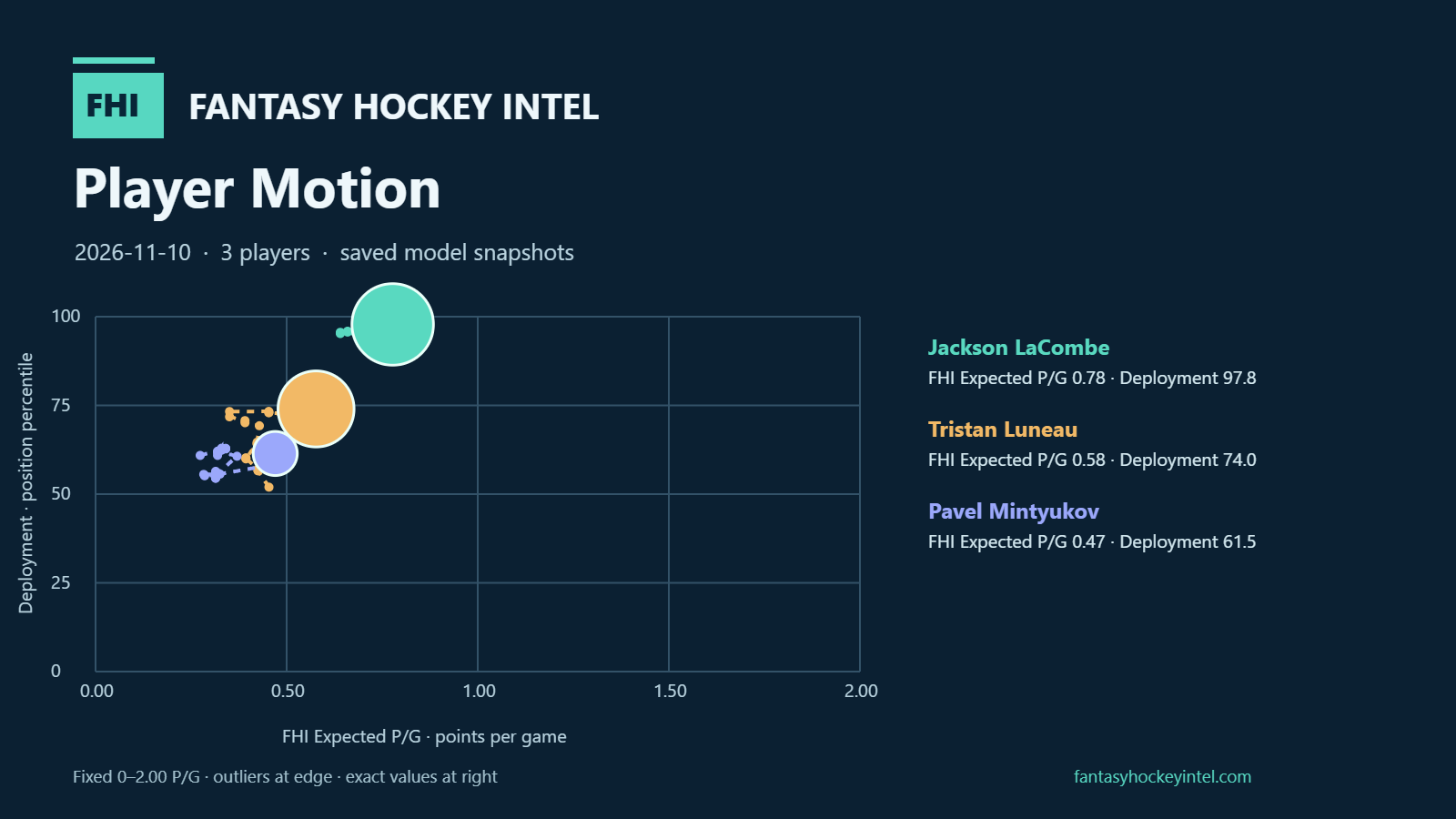
Anaheim’s crowded blue line. FHI’s Player Motion model highlights LaCombe’s established offensive role, Luneau’s emerging potential and Mintyukov’s more limited offensive opportunities.
Data through November 8, 2026.
Sources: NHL.com, Anaheim Ducks official team releases and game reports, Primitive Stats, NHL historical transaction records and player statistics.
About The Blind Spot
The Blind Spot explores the overlooked connections, hidden consequences and unexpected patterns shaping the NHL. Looking beyond the obvious numbers to uncover what they reveal about the game — and what they mean for fantasy hockey.