

Matthew Schaefer has transformed what the Islanders can do with the puck. But beneath his remarkable performances, an old problem remains — and the difference between individual brilliance and a functioning offense may become decisive when opponents learn where to apply the pressure.
Matthew Schaefer scored his first NHL hat trick against Columbus on November 17, adding another remarkable chapter to a young career that has already produced an extraordinary collection of achievements. The Islanders won 5–1, completing a three-game winning streak in which they outscored their opponents 16–5.
For a franchise that has spent years searching for more offensive creativity, Schaefer represents something unusually valuable: a defenseman capable of creating an attack almost entirely on his own.
He can retrieve the puck deep in his own zone, accelerate past the first forechecker and carry possession through neutral ice before the opposing defense has established its position. Few NHL defensemen can turn an ordinary breakout into an immediate scoring threat so consistently.
But his success raises a question that the Islanders’ improving results have not yet answered.
Has New York developed a better offensive system, or has it found an exceptional player capable of overcoming the limitations of the old one?
One player, two different Islanders teams
When Pete DeBoer took over as head coach in April, one of his first priorities was improving how the Islanders moved the puck out of their own zone.
He wanted forwards supporting their defensemen through the middle of the ice, creating shorter passing options and allowing the team to move through the neutral zone without surrendering possession. Those details formed part of what DeBoer called the playoff habits required to compete against stronger opponents.
Seven months later, the problem has not entirely disappeared.
In an October loss to Dallas, Brayden Schenn attempted a pass behind his own net that Jason Robertson intercepted before scoring from close range. Earlier in the same game, a promising Islanders offensive possession turned into a Dallas two-on-one rush that Jamie Benn and Tyler Seguin converted.
Against Carolina on November 5, a turnover by Tony DeAngelo preceded Logan Stankoven’s opening goal just 57 seconds into the game. Carolina’s pressure repeatedly disrupted New York’s puck movement, and the Islanders generated only one five-on-five scoring chance in the third period.
Those incidents illustrate different problems: decisions under pressure, defensive support after losing possession and the inability to establish sustained offense. None alone proves that the team’s breakout structure is fundamentally flawed.
But the concerns extend beyond individual mistakes.
After another difficult performance against San Jose, defenseman Logan Stanley spoke about a lack of connection between the forwards and defensemen during breakouts. Kyle MacLean described situations where the Islanders simply cleared the puck away instead of using shorter passes and supporting one another.
These are precisely the details DeBoer had emphasized when he arrived.
Schaefer can often bypass that complexity through individual skill. His skating creates options that other defensemen cannot reproduce. Early in his rookie season, Sportlogiq ranked him among the NHL’s leading defensemen in controlled zone exits and entries, while opponents were already adjusting how aggressively they challenged him.
That ability has made the Islanders far more dangerous in transition. According to BlueLineMetrics, New York ranks fourth in rush chances created per 60 minutes this season.
Yet the same model places the team 26th in defensive-zone escape efficiency and 19th in offensive-zone possession time.
The Islanders have become particularly dangerous when they move quickly. Sustaining possession and consistently building attacks remain less convincing parts of their game.
The improvement that hasn’t arrived
The distinction becomes especially revealing when Schaefer’s five-on-five minutes are separated from the rest of the team.
During the 2025–26 season, New York generated approximately 2.87 expected goals per 60 minutes with Schaefer on the ice, compared with 2.41 without him.
Through his first 19 appearances of 2026–27, those figures were 2.78 and 2.42.
The positive difference remains. More strikingly, the Islanders’ offensive production without Schaefer has barely changed.
The comparison comes from the same statistical model and uses five-on-five play in both seasons, although a completed 82-game campaign and a 19-game sample carry very different levels of certainty. Changing teammates, opponents and deployment also prevent the numbers from establishing Schaefer’s individual causal impact.
Still, the pattern is difficult to ignore.
New York has a different coaching staff, a changing forward group and several emerging offensive contributors. Its overall results have improved. But the expected offense generated during Schaefer’s absence has shown almost no corresponding increase.
That does not mean the Islanders are incapable of producing without him. Simon Holmström has taken on greater scoring responsibility, Victor Eklund has introduced another dynamic young forward, and Bo Horvat remains an important offensive contributor. Their recent performances demonstrate that the team has more attacking options than Schaefer alone.
Nor is Schaefer’s success merely concealing an otherwise identical team. The Islanders have improved their overall five-on-five expected-goal share compared with last season, and their defensive results during his minutes have become more encouraging.
What remains uncertain is whether the team’s improved ability to attack has become a repeatable collective strength.
A defenseman who can routinely escape pressure gives his teammates better starting positions. But the forwards still need to offer passing lanes, support the puck carrier and make the next decision correctly. Schaefer can create the first advantage without guaranteeing that the rest of the sequence works.
The distinction becomes particularly important against opponents capable of preparing specifically for New York’s preferred routes through the neutral zone.
During Schaefer’s rookie season, scouting analyst Vinh Cao observed that teams had already begun adjusting their forecheck against him. Rather than always attacking aggressively, opponents sometimes backed away to contain his speed and limit the space available behind their first line of pressure.
Schaefer adapted, using his movement without the puck to find different openings.
It is evidence of his intelligence and versatility, not a demonstration that he can easily be neutralized.
But it also reveals the challenge awaiting the Islanders. In a long playoff series, an opponent does not necessarily need to stop Schaefer entirely. It can concentrate on reducing his preferred opportunities and forcing other players to take greater responsibility for advancing possession.
A team that relies heavily on exceptional individual solutions may find that its greatest weakness only becomes visible when opponents stop allowing those solutions to develop naturally.
Building an offense beyond Schaefer
Mathew Barzal’s return offers New York an intriguing opportunity to address that problem.
For years, Barzal has been one of the team’s primary puck carriers, frequently responsible for initiating attacks from deep in his own zone. Schaefer provides a similar ability from a different position.
Their combination could give the Islanders two ways to beat pressure rather than simply two players competing to control the puck.
There have already been glimpses of that possibility. During Schaefer’s rookie season, Horvat described how opponents had to respect the young defenseman’s speed on power-play entries before he passed the puck back to Barzal. That threat created additional space for the forward.
Whether a similar relationship can develop consistently at five-on-five remains to be established. Barzal has only recently returned from injury, and the coaching staff is still determining how best to use him within the current lineup.
But the solution need not depend exclusively on the relationship between two stars.
The Islanders need more reliable support from their forwards during defensive-zone recoveries, cleaner passing options through the middle of the ice and additional ways to establish possession when the first breakout attempt is challenged.
Those improvements would make Schaefer more dangerous, not less important. He could attack from more varied positions rather than repeatedly being asked to solve the same problem.
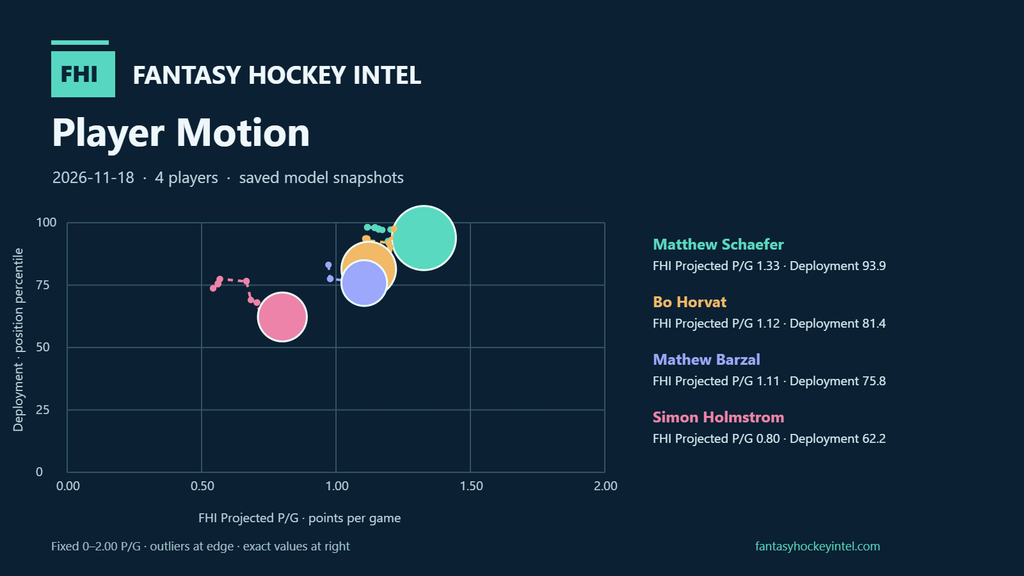
For fantasy managers, that distinction affects more than the young defenseman’s long-term projection. Schaefer’s exceptional individual involvement can support substantial fantasy value even when the team’s offense is inconsistent. The broader upside for Barzal, Holmström, Eklund and their teammates depends partly on whether New York can create opportunities without requiring its most gifted players to manufacture each attacking sequence themselves.
The Islanders have reason to be encouraged. Their young defenseman is becoming one of the NHL’s most influential offensive players, and the roster around him is beginning to offer more alternatives.
But DeBoer’s original challenge has not disappeared. The same details he prioritized in April remain central to whether this team can sustain its offense against opponents prepared to disrupt it.
Schaefer has changed what the Islanders can do.
The next step is changing what they can do without him.
Data through November 17, 2026. Five-on-five on/off data through November 16.
Sources: NHL.com and New York Islanders official game reports; Puckalytics; BlueLineMetrics; Sportlogiq tracking reported by The Hockey News; Newsday; Virtual Hockey Scout.
About The Blind Spot
The Blind Spot explores the overlooked connections, hidden consequences and unexpected patterns shaping the NHL. Looking beyond the obvious numbers to uncover what they reveal about the game — and what they mean for fantasy hockey.