

Power-play deployment tells us which players a coach trusts to score. Some NHL players receive valuable scoring opportunities for an entirely different reason: their coaches trust them to protect a lead.
Anthony Cirelli recorded 111 points over the past two NHL seasons. Nine came on the power play. Twenty came against an empty net.
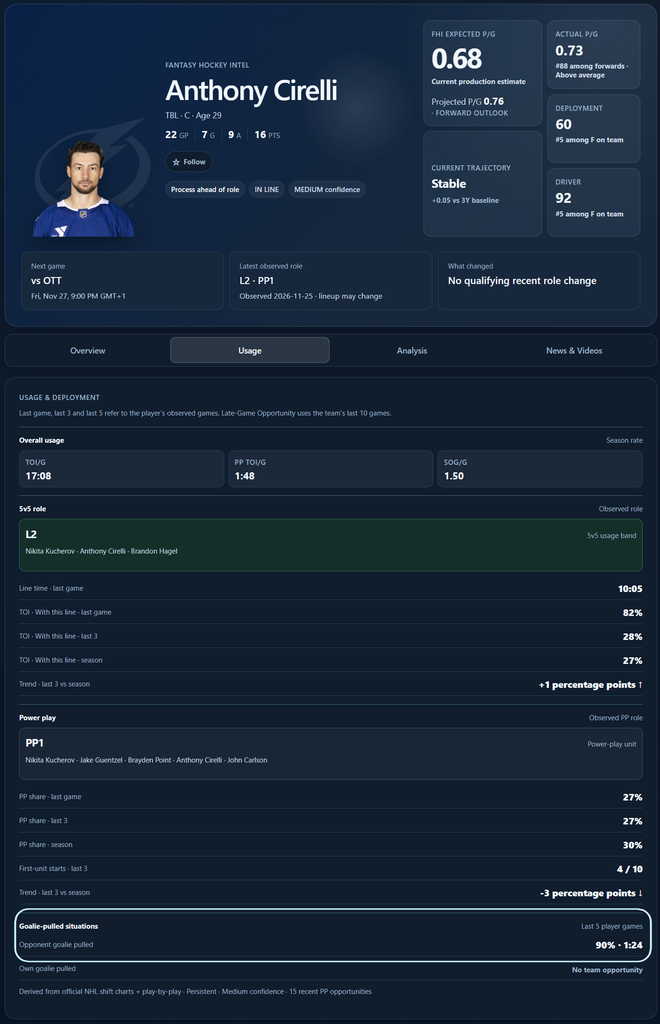
Forwards with established defensive responsibilities can generate a meaningful share of their offensive production in situations where their primary assignment is to prevent a goal.
Aliaksei Protas recorded 52 points for Washington last season, including ten against an empty net and just one on the power play. Six of his 25 goals came with the opposing goaltender pulled. Matthew Knies scored five of his 23 goals in the same circumstances, while Tom Wilson collected nine empty-net points during a 62-point season.
All three are established fantasy assets, yet one source of their production receives considerably less attention than their power-play deployment.
The minutes behind the points
Across the games covered by Fantasy Hockey Intel this season, ice time against an empty net amounts to just nine percent of total power-play time. These minutes can, however, be particularly valuable. Teams score in roughly 40 percent of opposing goaltender-pull situations, compared with a league-wide power-play success rate of around 21 percent.
Protas, Michael Amadio and Mattias Samuelsson all spend more time against an empty net than on the power play. Amadio has recorded five empty-net points in each of the past two seasons, while Samuelsson collected five last season despite barely featuring on Buffalo’s power play.
For players outside their team’s established power-play units, regular empty-net deployment can partly compensate for limited power-play opportunities. Some may be more fantasy-relevant than their conventional offensive assignments suggest.
Ottawa’s other scoring hierarchy
Shane Pinto and Dylan Cozens are producing at almost identical rates this season, with Cozens receiving far more power-play time.
Across the first 21 games, Pinto has played nearly 79 percent of Ottawa’s available time against an empty net. Cozens has played a total of three seconds. Even Tim Stützle and Drake Batherson rank well behind Pinto in those situations.
Pinto recorded eight empty-net points last season and is also a regular member of Ottawa’s extra-attacker unit. While Cozens receives more power-play time, Pinto is heavily involved whether Ottawa is chasing a goal or protecting a lead.
A similar hierarchy exists in Washington. Dylan Strome is among the first choices when the Capitals pull their goaltender but has not registered a single second against an empty net in the covered games. Tom Wilson is a regular choice when defending a lead, and his empty-net production has increased from four to six to nine points over the past three completed seasons.
The pattern extends to defensemen. Owen Power has received nearly twice Rasmus Dahlin’s share of Buffalo’s available empty-net minutes, with Mattias Samuelsson also among the team’s preferred options.
Adam Fox has collected 15 empty-net points since the beginning of the 2024–25 season, including four assists this season. For defensemen, winning possession and starting the breakout can contribute to empty-net production without a shot on goal.
Late-game assignments also offer another way to evaluate young players.
Adam Fantilli and Leo Carlsson receive nearly identical shares of their teams’ power-play minutes and are both prominent when their own goaltenders are pulled. Against an empty net, however, Fantilli has received 66 percent of Columbus’ available time, compared with 21 percent for Carlsson in Anaheim.
Detroit’s Emmitt Finnie has played 55 percent of the Red Wings’ recorded time against an empty net at just 21 years of age, although his sample remains small. Frank Nazar and Zach Benson are also receiving substantial minutes in these situations.
For keeper and dynasty managers, these assignments offer a glimpse of how coaches view developing players beyond their offensive production. A young forward who earns minutes at both ends of a close game may be better positioned to retain an important role when his scoring slows.
An overlooked fantasy edge
When comparing players with similar production, look beyond their power-play assignments. How much time do they spend against an empty net? Are they also involved when their own team pulls its goaltender?
Fantasy Hockey Intel’s player pages allow you to compare ice time across these game situations. Look at both the actual minutes and the player’s share of his team’s available time. The former captures the volume of opportunity; the latter offers insight into his role.
Empty-net opportunities remain relatively scarce, and their frequency depends heavily on team performance. They should complement, rather than replace, conventional deployment analysis.
Most fantasy managers already monitor power-play usage. Paying attention to the minutes your competitors overlook may give you an edge.
Notes from the empty-net leaders
- Nikita Kucherov recorded 36 empty-net points across the past three completed seasons, ahead of Nathan MacKinnon (34) and Brandon Hagel (33).
- Mikko Rantanen recorded 16 empty-net points in 2024–25, including nine goals, during a season split between Colorado, Carolina and Dallas.
- Nathan MacKinnon and Connor McDavid shared the NHL lead in 2025–26 with 13 empty-net points each. Eight of MacKinnon’s 53 goals came against an empty net.
- Alex Ovechkin recorded 18 empty-net goals and 23 empty-net points over the past three completed seasons.
- Mark Scheifele and Dylan Larkin each collected 22 empty-net points over the same period, while David Pastrnak, Kyle Connor and Lucas Raymond each recorded 20.
- Kirill Kaprizov recorded eight empty-net points through 26 games this season, followed by Leon Draisaitl with six through 27.
Data through November 25, 2026.
Data note: FHI’s situational ice-time data covers a subset of NHL games and may include goalie-absent situations other than conventional late-game goaltender pulls. Some individual samples remain small. Historical scoring totals and current-season deployment cover different periods and should not be used to calculate comparative scoring rates.
Sources: NHL official player statistics (2023–24 through 2026–27); Fantasy Hockey Intel situational player and team deployment data.
About The Blind Spot
The Blind Spot explores the overlooked connections, hidden consequences and unexpected patterns shaping the NHL. Looking beyond the obvious numbers to uncover what they reveal about the game — and what they mean for fantasy hockey.