

When Brady Tkachuk returned to Ottawa on October 21, it took him barely ten minutes to remind Senators fans of what they had lost. His power-play goal for Florida came from close range, the kind of finish he had made a trademark during eight seasons in Canada’s capital. Ottawa ultimately won the game 5–1, but the sight of Tkachuk scoring against his former team offered another reminder of a problem the Senators have spent the opening weeks of the season trying to solve.
One of the players helping them search for an answer is Stephen Halliday, a 24-year-old forward who entered the season with just 30 NHL games behind him and little indication that he would become a central figure in Ottawa’s offensive plans.
Against Florida, Halliday assisted on Tim Stützle’s power-play equalizer before adding a shorthanded goal. His two-point performance was encouraging, but his growing role on the Senators’ first power-play unit is the more significant development. Despite spending much of his even-strength time in the bottom six, Halliday has been given an opportunity alongside Stützle, Drake Batherson, Dylan Cozens and Jake Sanderson.
The decision is curious given Ottawa’s alternatives. Claude Giroux remains one of the league’s most experienced playmakers, Fabian Zetterlund possesses a dangerous shot, and André Burakovsky offers established offensive ability. All three have stronger NHL scoring credentials than Halliday, yet Travis Green has increasingly entrusted the young forward with some of the team’s most valuable offensive minutes.
The explanation may lie less in Halliday’s current production than in the type of player Ottawa has been missing since Tkachuk left.
The hole Tkachuk left behind
When Ottawa traded Tkachuk to Florida in June, the Senators lost far more than a reliable goal scorer. They lost one of the league’s most disruptive offensive players, someone whose influence on a game was often most apparent when he didn’t have the puck.
Tkachuk’s effectiveness around the crease came from a combination of anticipation, aggression and physical strength. He occupied defenders, screened goaltenders, won loose pucks and repeatedly forced opposing penalty killers to collapse toward their own net. Even when he wasn’t directly involved in a scoring play, his presence could create the space that teammates needed elsewhere on the ice.
Under Travis Green, Tkachuk had been the primary net-front presence on Ottawa’s first power-play unit, drawing defenders toward the crease and creating space for the team’s playmakers.
Ottawa has plenty of players capable of moving the puck and generating shots, but recreating Tkachuk’s work around the net presents a different challenge. It requires more than inserting another productive forward into the lineup, particularly when the existing power-play structure has been developed around a player with such an unusual combination of physical and offensive abilities.
William Eklund’s ankle injury on October 8 further complicated Ottawa’s options. Eklund had been part of the early-season power-play plans, and his expected absence of 10–12 weeks left Green searching for another combination capable of generating chances.
The solution now taking shape is interesting because Halliday does not resemble Tkachuk in several important respects.
Halliday brings size, but a different kind of offense
At 6-foot-4 and 214 pounds, Halliday has the physical dimensions to occupy the dangerous areas around the crease. His offensive instincts, however, are closer to those of a playmaker than a traditional power forward.
Halliday built his reputation through excellent vision, anticipation and puck distribution. He can protect the puck using his reach, recognize passing lanes and find teammates from congested areas of the offensive zone. Scouts have also questioned whether he consistently makes full use of his size, noting that he can sometimes prefer working on the perimeter rather than engaging physically around the net.
Those observations make a direct comparison with Tkachuk difficult. Where Tkachuk thrives on confrontation and second chances, Halliday is more comfortable finding space and creating opportunities through positioning and puck movement.
His power-play goal against New Jersey on October 12 illustrated that approach. Halliday moved into open ice between the faceoff circles, received a pass from Stützle and converted from the slot. There was no prolonged battle in front of the goaltender or scramble for a rebound; his contribution came from recognizing where the defensive coverage had created an opening.
Stützle has praised Halliday’s intelligence, skill and ability to get to the net, suggesting that his teammates are beginning to recognize the value of his particular style. Halliday may not reproduce Tkachuk’s physical presence, but he offers something Ottawa can use in the same general areas of the ice.
Dylan Cozens provides another part of the equation. A strong, direct forward who can attack the net and finish scoring opportunities, Cozens brings a more physical element to the unit. Together, he and Halliday could allow Ottawa to distribute the responsibilities previously handled by Tkachuk across two players rather than expecting one forward to replace him.
Such an arrangement would also leave Stützle and Batherson free to concentrate on creating plays, with Sanderson controlling much of the distribution from the blue line. On paper, the combination offers a reasonable balance between playmaking, shooting and interior presence.
Whether it produces the same problems for opposing penalty killers is another question.
Why not Giroux, Zetterlund or Burakovsky?
Green’s personnel choices become easier to understand when the alternatives are considered in terms of their playing styles rather than their career statistics.
Zetterlund is a powerful shooter whose quick release makes him dangerous when he receives the puck in space. He can compete physically, but much of his offensive value comes from finishing opportunities rather than directing play from crowded central positions. Burakovsky, meanwhile, is most effective when he can use his skating and puck-handling ability to establish possession, enter the offensive zone and create passing opportunities.
Giroux brings a different set of strengths. His faceoff ability, vision and passing remain valuable, particularly when a power play needs someone capable of reading defensive pressure and finding teammates through narrow openings. His experience also makes him a natural candidate for an important offensive role, even at this stage of his career.
Ottawa already has much of that creativity in Stützle and Batherson, however, and adding another player who prefers handling the puck on the perimeter might not address the areas Green wants to improve.
Giroux was already working with PP2 during training camp, so Halliday’s promotion should not be viewed as a direct replacement of the veteran. Burakovsky has received opportunities on the first unit during October, while Zetterlund has remained among the options for the second group. Ottawa has been experimenting with its entire power-play structure rather than making a single personnel change.
The current arrangement suggests Green is prioritizing how the five players complement one another. Halliday offers a large target in central areas without sacrificing passing ability, while Cozens supplies another forward capable of attacking the crease. Neither is a complete substitute for Tkachuk, but their combined attributes may help Ottawa recover some of what his departure removed.
There is an obvious objection to this explanation: if the idea makes tactical sense, why has Ottawa’s power play been so ineffective?
The opportunity is growing faster than the results
Across the first ten measured games, the first unit scored four goals in 46:37 of power-play time, equivalent to approximately 5.15 goals per 60 minutes. The second unit scored three times in 25:27, a rate of approximately 7.07 goals per 60.
Neither sample is large enough to establish which unit is more effective, especially given the changes in personnel, but PP1 has hardly established itself as the obvious answer to Ottawa’s problems.
Halliday’s individual production has improved with his opportunity. He has five points in eleven games, including three on the power play, matching the number of power-play points he recorded across 30 NHL appearances last season. His recent deployment is even more striking, with his average power-play ice time climbing to 4:16 per game over his latest five appearances.
His performance at five-on-five offers a less encouraging picture.
Through his first ten games, Ottawa controlled just 35.9% of expected goals during Halliday’s five-on-five minutes, compared with 56.1% last season. The current sample is limited, and changes in linemates, opposition and deployment can all influence on-ice expected-goal results. Nevertheless, the contrast suggests that his broader even-strength impact has not developed at the same pace as his power-play responsibilities.
Halliday is therefore occupying an unusual position. His offensive opportunity has increased substantially, but the improvement has come primarily through coaching decisions and specialized deployment rather than a demonstrated breakthrough across all situations.
For fantasy managers, that creates an interesting opportunity with an equally obvious vulnerability. Regular PP1 minutes alongside Stützle could support a considerably higher scoring rate than Halliday’s five-on-five role would normally suggest, particularly if Ottawa begins converting more consistently. Yet his production will remain sensitive to changes in the power-play lineup unless he also establishes a larger even-strength role.
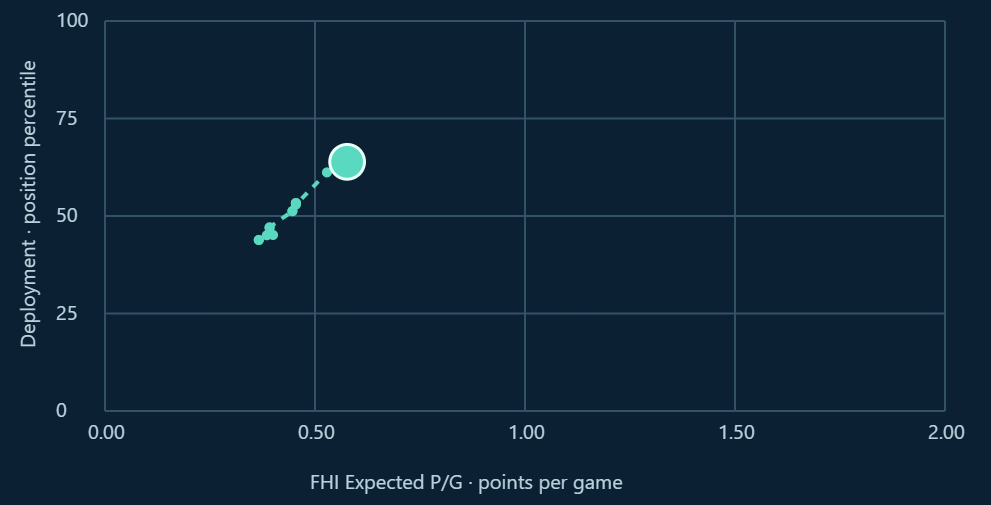
First-unit responsibility, fourth-line minutes
Halliday’s recent movement between lines reinforces that uncertainty.
During the middle of October, he spent time alongside Stützle and Batherson at even strength, offering the possibility that his increased power-play responsibility might develop into a permanent top-six assignment. By October 21 and 22, however, he had returned to a lower line with Nick Cousins and Hayden Hodgson while retaining his place on PP1.
Green is clearly willing to use Halliday in important offensive situations, but that confidence has not yet extended to a consistent role against the opposition’s better players at even strength.
It may reflect the specific responsibilities he is being asked to perform on the power play. Halliday’s size and passing instincts can be useful when Ottawa has an extra skater and the time to establish possession, while the demands of five-on-five hockey expose different aspects of his game. His relatively modest NHL experience also gives the coaching staff reason to manage his responsibilities carefully.
The arrangement could persist if Halliday continues to contribute on the power play without significantly improving his five-on-five performance. It could equally disappear if Ottawa decides another player provides a better option.
Burakovsky remains capable of returning to the first unit, Giroux continues to offer a proven combination of passing and experience, and Zetterlund’s shooting ability gives Green another way to alter the unit’s attacking approach. Eklund’s eventual return will add further competition once he is healthy.
Halliday has earned an opportunity, but he has not yet made himself indispensable.
Can Ottawa rebuild its power play without Tkachuk?
The Senators’ early-season struggles should not obscure the possibility that Green is attempting something more deliberate than simply rewarding a young player’s recent production.
Ottawa spent years benefiting from Tkachuk’s ability to influence defenders around the crease. His departure changed the balance of the power play, and replacing that influence requires the team to reconsider how its remaining forwards create chances.
Halliday’s emergence fits that problem. He provides size, intelligence and offensive awareness in central areas, while Cozens can supply a more direct and physical attacking presence. Together, they may allow Ottawa to build a different route toward the same objective: forcing defenders to protect the space close to their own net and creating opportunities for the playmakers operating around them.
Playing in Tkachuk’s former territory is one thing, however. Reproducing the pressure he consistently created is another, and the Senators have not yet demonstrated that their new combination can deliver comparable results.
Halliday’s development adds another layer to the story. His power-play role has expanded considerably in a short period, while his limited five-on-five production leaves open the question of whether he is becoming a more complete offensive player or simply benefiting from an unusually valuable assignment.
FHI’s deployment indicators should be particularly revealing over the coming weeks. Sustained first-unit minutes would support his short-term fantasy outlook, but improved individual chance generation and a more stable even-strength role would provide stronger evidence of a lasting breakthrough.
Ottawa’s power-play efficiency will also matter. A tactical adjustment can be entirely reasonable in theory and still fail to produce enough dangerous chances to justify the personnel decisions behind it.
For now, Halliday represents an intriguing experiment rather than a proven solution. Green appears willing to prioritize his particular combination of size and playmaking over the greater offensive experience of several alternatives, but the resulting unit is still searching for consistency.
The FHI takeaway
Halliday’s fantasy value has risen because his power-play opportunity has expanded, not because his overall offensive performance has taken a comparable step forward. His role alongside Ottawa’s established stars offers genuine upside, but its sustainability will depend on whether Green’s new-look power play begins producing better results.
Ottawa was never going to replace Brady Tkachuk simply by finding another player capable of scoring thirty goals. His influence extended into the way opponents defended, how his teammates found space and where the Senators generated their most dangerous chances.
Stephen Halliday may eventually become an important part of the solution, even if he never comes close to resembling the player Ottawa lost.
The question now is whether the Senators can turn an interesting tactical experiment into a functioning power play.
Data through October 22, 2026. Power-play assignments and ice time are based on recorded shift data. Five-on-five expected-goal figures are from Puckalytics. Early-season samples are limited, and interpretations of Ottawa’s tactical approach are based on observed deployment rather than a confirmed statement of coaching intent.